Three Unknowns
French Artists

Questions of Authenticity
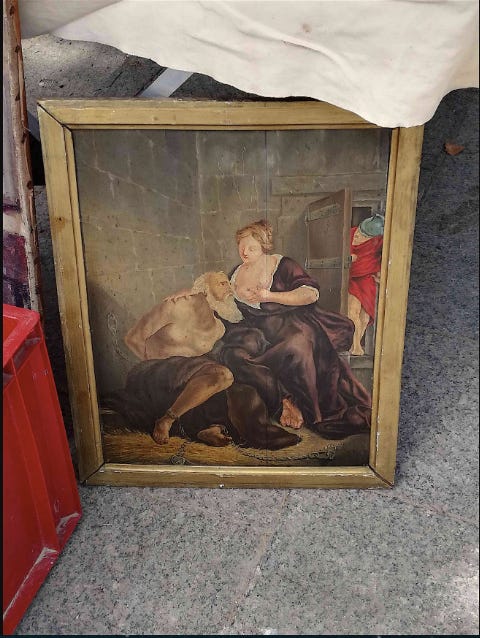
I wasn’t looking for paintings when it caught my eye. A little surprised no one else was paying attention but maybe their walls are already crowded with skillful naifs. Because that’s what it is, isn’t it ? Doubts linger. Max Ernst making a private joke ?
The brocante at Malakoff is only a few short steps outside of Paris at Vanves, where there are miles of tables, old silverware neatly arranged, sheets and pillowcases neatly folded in transparent packaging, wallets and purses in good condition, books not so many, curtain material, maybe Arabian rugs, old baby strollers, board games in stacks, toy trains, more rugs, winter coats and clothes of all kinds and shoes, lest we forget, used shoes in neat rows set out on the ground or on a cloth, some in good repair, some not. You wonder what motivates anyone to start collecting old shoes for resale but I sometimes lean in for a closer look, just on the odd chance.
(I had a theory that the French never actually throw anything away, they save whatever it is and when they have enough of them, take them to the weekend fleamarket and put them on sale. Prices flexible. Goes for old phono albums, tools, cutlery, shower curtains, African sculptures, all those small household helpers which barely have names but which are indispensable, and more. They spend a certain amount of time at the new person’s house before returning to the tables. Personal engagement with the seller tends to win out over the stated price.)
The painting was sitting on the ground alongside tables piled with prints and old books by other, even lesser known artists. I rifled through my imagination, trying to recall what biblical or mythological scene it depicted. A saint, visited by a well-born lady who offers her breast to the prisoner while the jailer, in red with an odd hat, looks on from the doorway. (We are him, from the other side.) What’s the story ? A medieval act of mercy, maybe not a saint at all – a philosopher or a criminal. Maybe the painter cooked the whole thing up. The man in charge of the table was busy elsewhere. I reget not buying it there and then.
An Invisible Artist
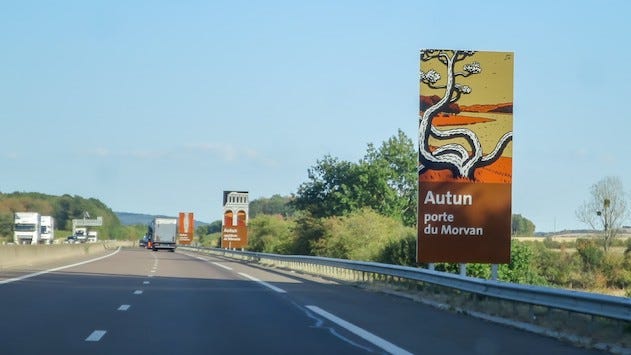
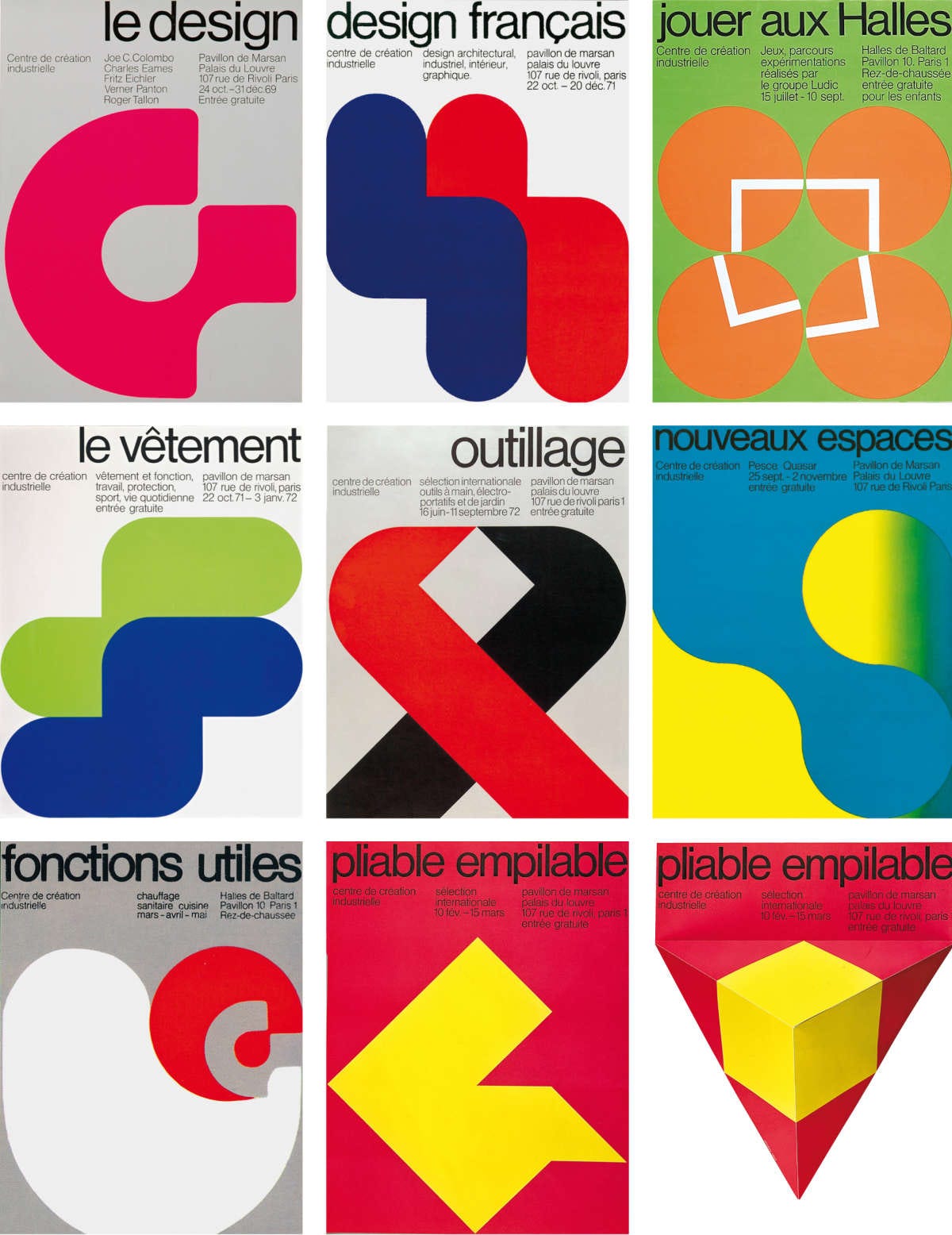
One of France’s most famous artists died recently and hardly anyone knows his name. His work is on permanent display all over the country and it leads people to all sorts of discoveries, which is one of the things art can do, even if this isn’t fine art. It’s signage for the towns along the big auto routes, actual enticement to ditch the pay road for the towns and two-laners. Autun gets three one after the other, like windows in a department store eager to lure you in.
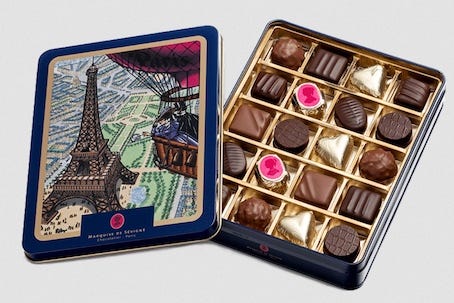
Jean Widmer was born in Frauenfeld, Thurogovie, Switzerland in March 1929, studied under Johannes Itten in Zurich and hit Paris with a few artist friends in the early Fifties, when the capital was buzzing in the Post-War years and design was in demand. Like many other artists in France and elsewhere he started in vitrines at the big stores, which change every few weeks and put a high price on grabbing the prospective buyer’s attention. He worked for Marquise de Sevigné, a famous old house of chocolate deluxe and quickly branched out.
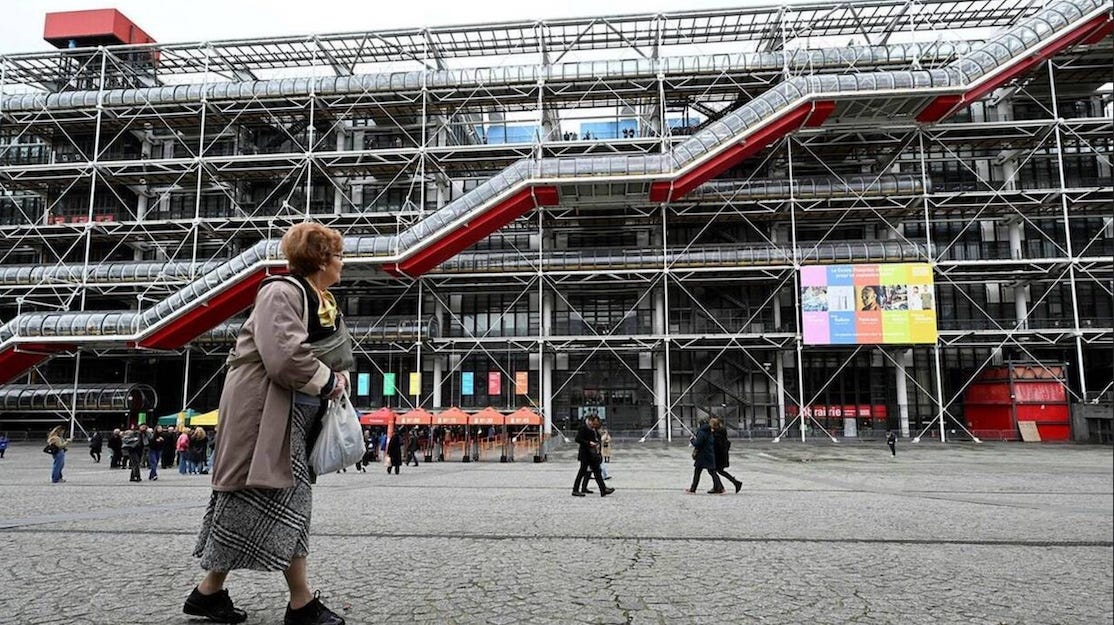
In the 1970s he and his team set about creating une signalétique culturelle pour les autoroutes du sud de la France pour rompre la monotonie des trajets en voiture tout en suscitant la curiosité de l’automobiliste pour l’espace naturel, le patrimoine artistique, architectural et urbain des régions traversées, as the job description puts it so elegantly. His design for the Beaubourg seizes on the building’s outre detail, the remarkable in-your-face enclosed exterior staircase, both semaphore and reality now lodged in people’s brains with no need for words.

Chesnut brown - one of France’s three favorite colors, along with blue and bordeaux (cordovan, bull’s blood) – dominates the highway calls. They sometimes remind me of old Dijon mustard, with grains you feel rolling around your tongue. (A well as Fall, harvest time, the new beaujolais, etc.) They were an immediate hit and his team began creating signs for the entire country, which is why I’d argue he’s the most well-known artist in France, graphic artist if you want to quibble. They’ve led more than one family to quit the highway to see what’s out there.
What’s really spectacular is how this unassuming Franco-Swiss gave the country an ideogrammic language that is simply everywhere, not just the highways. You immediately recognize his signage for the Centre Pompidou. He developed a style that left fonts far behind in favor of recognizable, even unforgettable, visual cues. His influence wasn’t limited to France: when Mexico City was modernizing its subway system, it used Aztec ideograms to designate the different stops, a brilliant move in a city where many country folk pouring in from the countryside couldn’t read.
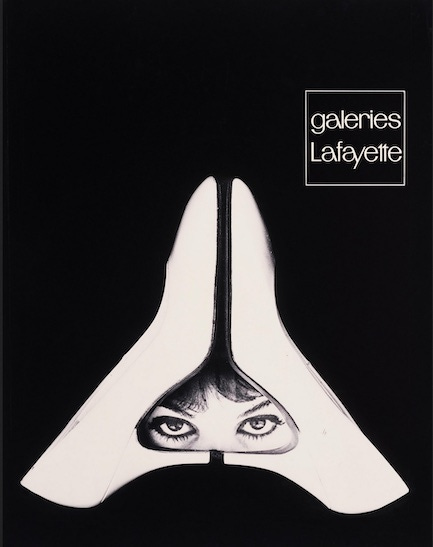
There was one design Widmer didn’t sell, to Galeries Lafayette, although I’m not sure why.
Sunday Afternoon with Riffs At Clignancourt
I found the painting below at Clignancourt, Paris Nord, where the street vendors spread out on narrow streets under the roaring Peri-Feri overhead. (That’s where the shoe sellers are.) It’s probably the most famous of the Paris brocantes, and if you can get past the floating city of phone vendors, household items and old clothes in piles or on racks, you enter a maze of streets with commerce in fine furniture, rare book shops and small restaurants. There’s a stadium nearby for Paris’s second football team.
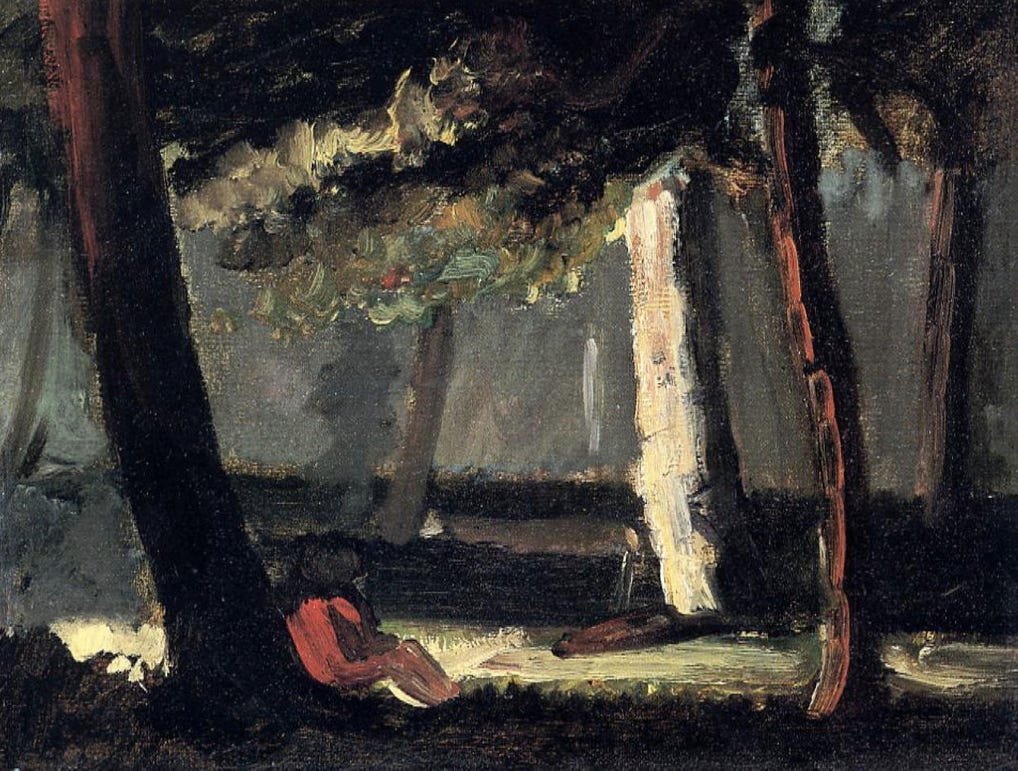
Smudged handwriting on back says, Guillemin by the side of the road. Guillemin and a friend, maybe. A beat idyll, with someone making a fire a little further in the woods, Suspect I threw my money away. Could be a copy of some other painting. Hard to tell. Maybe you know ?
n.b.
Tragic or maybe tragi-comic that this essay concerns a graphic designer who died in his late Nineties. Yes ? What I mean can only be calculated by the absence of others. In the great liberal Market Dispensation of the last sixty years, the Society of the Consumer (marrying Debord to Pasolini), there are no acclaimed or disputed figures striding the the Visual Landscape. Plenty of so-and-sos with their takes on Hierarchy This, Patriarchy That, plenty of earnest curators telling us why this artist is good for you but nobody you can work up a lather arguing over. Come out, come out, wherever you are.
Pitching Pennies Into the Pot
Another freebie. Subscribe if you care to, or tip a coin in the guy’s cup, keeps the coffee perking here. Merci bien! et much obliged.