Why Read Pascal Now ?
Contemporary Iterations of Old Questions

Monday’s Mull on Tuesday. Updated 9.4.26 with a new ending so worth your time to scroll through.
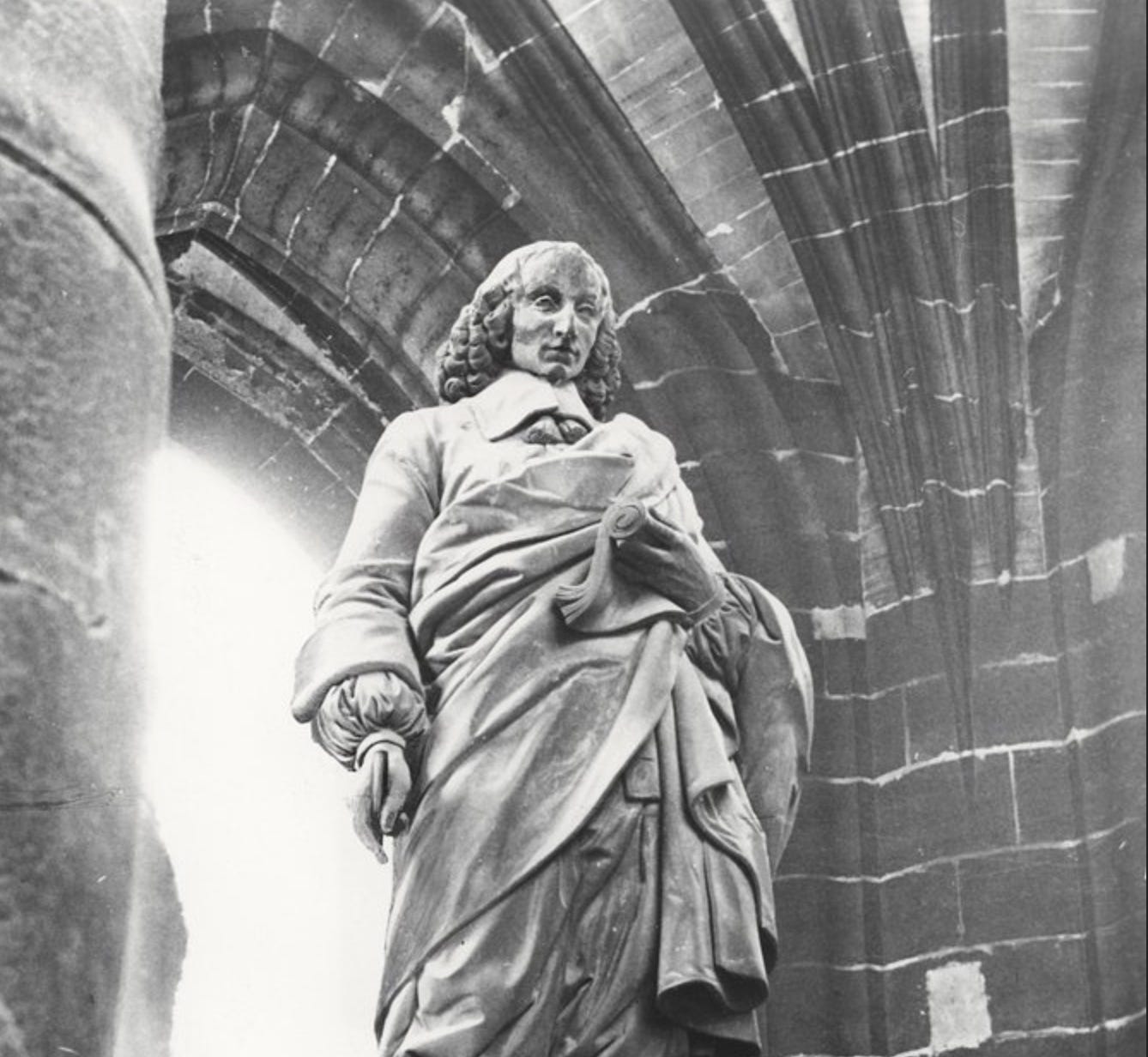
« Pascal, fou sublime, né un siècle trop tôt. » Voltaire
Straight on, the regard is fierce yet dreamy, determined, forensic – lost in his thoughts. Like the clown in the circus, he’s waiting for you to say something he can use. The sculptor has caught him contrapposto, coming towards you, half giant, half golem as he paces the atrium of the Tour St.-Jacques.
Paris bustles by on all sides, two grand theatres facing off across a busy intersection, sphinxes on the median isle that everyone hurries by, Beaubourg warrens the other direction via Rue Nicholas Flamand, named for a medieval alchemist, although people argue to this day what he was really up to. (Marrying rich widows, turning lead into gold.) The park is lined with benches and bushes, two memorials to the poet Nerval, the walkway where Nijinsky paced between rehearsals at the Châtelet...lovers and smokers taking a break from exigencies of life and death.
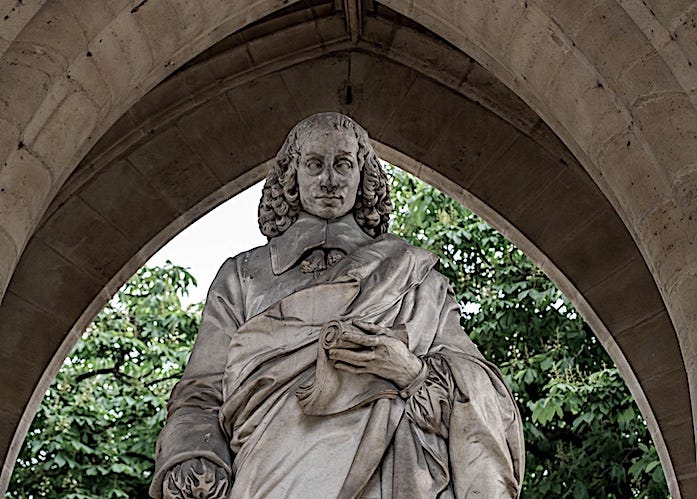
Blaise Pascal, French polymath: mathematician, inventor, philosopher, moralist and theologian. For two years in 1647 and ’48 he used the tower of the then still-extant church for some of the earliest experiments in falling bodies and air pressure.
Voltaire’s “Sublime madman born a century too soon,” is a neat encomium suggesting that Pascal’s scientific experiments and philosophic enquiries would have been right at home in the Enlightenment, leaving unspoken the assumption that he would have dropped the Religious Bit in the century of Montesquieu, Diderot, Rousseau and others. Wouldn’t be Pascal then, would he?
We know Pascal for his famous Wager: Accepting Christ before you die costs you nothing, and gives you access to eternal life. If none of that is true, you’ve lost nothing. If on the other hand, you persevere in disbelief and it is true, you are excluded and go straight to the fiery place where the loud talkers hang out or perhaps just rot away peaceably. While most take the Wager as aimed at unbelievers, it isn’t much consolation to the faithful, inasmuch as it gives doubt equal time.
The scientist’s task is to confirm his hunches – or throw them away and start over. The philosopher aims to upset our understanding, to turn things inside out. Ever since they invented existence, they’ve been torturing us with it. We can’t live without second guessing ourselves or laying bets on life and the hereafter.
Hence the Wager, an insurance policy against the ineffable and inevitable. Clever enough to seduce the intelligent on their deathbed, its only requirement is that you repudiate your earlier existence. May they burn in hell those arrivistes who wait until the last moment to accept Jesus Christ as their lord and savior! Or not, as individual cases come to the Lord’s attention. Better to leave eternity to divine embalmers and gazillionaires in Silicon Valley.
Upon Further Investigation
The meat of the matter is elsewhere. Reducing Pascal’s Pensées to the Wager and other popular gems obscures a living being in the trammels of existence. So, yes, with “The heart has its reasons which reason knows not,” (brutally reduced in Renoir’s Grand Illusion to “Everybody has their reasons”) and Tout malheur des hommes vient d’une seule chose qui est de ne savoir demeurer en repos dans une chambre – ‘All of humanity’s problems stem from man’s inability to sit quietly in a room alone” – we inch closer to a man of our feverish, distracted times.
All human history is one immortal man who continually learns.
In the mad, sometimes lucid, all too often drug-addled narrative that is Valis, P.K. Dick’s masterpiece of California philosophical intoxication, Horselover Fat, the author’s doppelganger, a deranged sweetheart with LOSER scrawled across his forehead, falls prey to synaesthetic visions and revelations. (For sheer conversational bravado à l’américain, it’s the best thing since those long passages in Miller’s Crucifixion trilogy.) The Pensée above has pride of place in Horselover’s journals, iterated numerous times as he tries to understand the how or who of salvation and eternal life. Dick knew what Bay Area tyros really want.
If our condition really was as happy as we put on, we wouldn’t need to entertain ourselves with thinking.
We sail within a vast sphere, ever drifting in uncertainty, driven from end to end.
Bohumil Hrabel crafted his own version of this Pensée: “We are in a large boat, so big we never know we are in a boat. And it sails so smoothly we never know it’s moving.” If these notes lead one person to ask, Who the hell is Bohumil Hrabel, it’s done its bit.
The silence of these infinite spaces frightens me.
We never do evil so wholeheartedly and joyfully as when we do it with a clear conscience.
The only true virtue is to hate ourselves.
True morality makes a mockery of morality.
Man’s sensitivity to the little things and insensitivity to the greatest are the signs of a strange disorder.
People almost invariably arrive at their beliefs not on the basis of proof but on the basis of what they find attractive.
You see the invisible lines connecting Pascal to our world, yes ? A French Catholic thinker probably has special hurdles to prove his present relevance.
Churches all over France are enjoying a resurgence, packed to the gills if my Good Friday experience is any indication. (Something is happening here.) Let’s end this brief tour by quoting one of the few deleted Pensées – indeed, it was blotted out, presumably by Pascal himself. It’s quite simple and opens up a discussion our cultures are having, even if liberated moderns who believe in nothing don’t know it.
“Lequel est le plus croyable des deux, Moïse ou la Chine ?”
Of the two which is more believable, Moses or China ?
You can maybe see why Pascal cut it. Everything is called into question, the basis and endurance of civilizations, belief, God Almighty himself. Can a culture persist, even thrive, without God continually rearranging the furniture ? Pascal hardly seems to have lived a century too early.
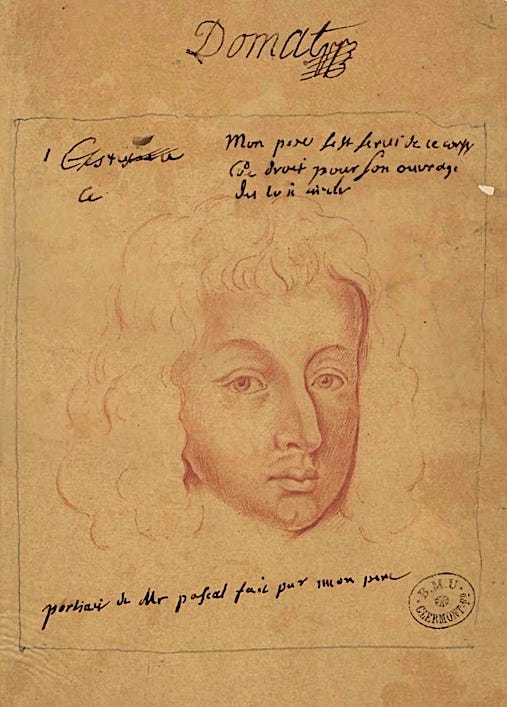
Philosophers never age: readers still puzzle over the shards of Heraclitus, looking for pathways through the Black Forest of Heidegger. But French, Catholic and a philospher ? We confront multiple biases: French, savoir faire, a millennial culture that claims to be modern while constantly applying their dread humanism to everything in a managerial age, it’s a bit much — most prefer to google and oogle impressive monuments and leave it at that; Catholicism implies that like sheep we are artfully being led into a pen of some sort; the never-ending carnival of philosophers in the French press and on TV is enough to make anyone doubt the business of well-paid researchers at one academic institution or another.
What then of Pascal, for whom faith and doubt walked hand in hand as he climbed the stairs at Tour St.-Jacques, eager to understand how the circulation of air affected falling bodies ?
And
Interested readers will want to visit Arnaud Bertrand’s substack where he goes into that last question about China in more depth.
“I had observed that the men who were most in life, who were molding life, who were life itself, ate little, slept little, owned little or nothing. They had no illusions about duty, about the necessity of work, or the preservation of the State. They were interested in truth and in truth alone. They recognized only one kind of activity—creation.” - Henry Miller
Pier Paolo Pasolini somehow made it to Mass on a more or less regular basis. I’d argue that his work holds up better than that of many of the philosophers of his age.
Here it comes: readers who appreciate can buy a coffee for the scribbler here. Enemies can, too. And no, if I’m only small c Catholic, that makes me Catholic-adjacent in my adopted country whose mores and morale were cooked in that pot for centuries, all shades of the political spectrum inclus. A vast Right-Wing conspiracy or a late education, take your pick.